Ecce Homo by Friedrich Nietzsche & Anthony M. Ludovici
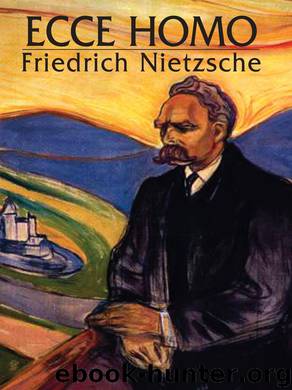
Author:Friedrich Nietzsche & Anthony M. Ludovici [Nietzsche, Friedrich]
Language: eng
Format: epub
ISBN: 9780486146706
Publisher: Dover Publications
Published: 2012-10-06T04:00:00+00:00
3
The extent to which I had by means of these doctrines discovered the idea of “tragedy,” the ultimate explanation of what the psychology of tragedy is, I discussed finally in The Twilight of the Idols (Aph. 5, part 10). . . . “The saying of yea to life, and even to its weirdest and most difficult problems: the will to life rejoicing at its own infinite vitality in the sacrifice of its highest types—that is what I called Dionysian, that is what I meant as the bridge to the psychology of the tragic poet. Not to cast out terror and pity, or to purge one’s self of dangerous passion by discharging it with vehemence, —this was Aristotle’s11 misunderstanding of it,—but to be far beyond terror and pity and to be the eternal lust of Becoming itself—that lust which also involves the joy of destruction.” . . . In this sense I have the right to regard myself as the first tragic philosopher—that is to say, the most extreme antithesis and antipodes of a pessimistic philosopher. Before my time no such thingexisted as this translation of the Dionysian phenomenon into philosophic emotion: tragic wisdom was lacking; in vain have I sought for signs of it even among the great Greeks in philosophy—those belonging to the two centuries before Socrates. I still remained a little doubtful about Heraclitus, in whose presence, alone, I felt warmer and more at ease than anywhere else. The yea-saying to the impermanence and annihilation of things, which is the decisive feature of a Diony-sian philosophy; the yea-saying to contradiction and war, the postulation of Becoming, together with the radical rejection even of the concept Being— in all these things, at all events, I must recognise him who has come nearest to me in thought hither to. The doctrine of the “Eternal Recurrence”—that is to say, of the absolute and eternal repetition of all things in periodical cycles—this doctrine of Zarathustra’s might, it is true, have been taught before. In any case, the Stoics, who derived nearly all their fundamental ideas from Heraclitus, show traces of it.
Download
This site does not store any files on its server. We only index and link to content provided by other sites. Please contact the content providers to delete copyright contents if any and email us, we'll remove relevant links or contents immediately.
| Anthropology | Archaeology |
| Philosophy | Politics & Government |
| Social Sciences | Sociology |
| Women's Studies |
The remains of the day by Kazuo Ishiguro(8999)
Tools of Titans by Timothy Ferriss(8395)
Giovanni's Room by James Baldwin(7346)
The Black Swan by Nassim Nicholas Taleb(7129)
Inner Engineering: A Yogi's Guide to Joy by Sadhguru(6794)
The Way of Zen by Alan W. Watts(6614)
The Power of Now: A Guide to Spiritual Enlightenment by Eckhart Tolle(5781)
Asking the Right Questions: A Guide to Critical Thinking by M. Neil Browne & Stuart M. Keeley(5775)
The Six Wives Of Henry VIII (WOMEN IN HISTORY) by Fraser Antonia(5515)
Astrophysics for People in a Hurry by Neil DeGrasse Tyson(5189)
Housekeeping by Marilynne Robinson(4447)
12 Rules for Life by Jordan B. Peterson(4304)
Ikigai by Héctor García & Francesc Miralles(4274)
Double Down (Diary of a Wimpy Kid Book 11) by Jeff Kinney(4272)
The Ethical Slut by Janet W. Hardy(4251)
Skin in the Game by Nassim Nicholas Taleb(4248)
The Art of Happiness by The Dalai Lama(4130)
Skin in the Game: Hidden Asymmetries in Daily Life by Nassim Nicholas Taleb(4006)
Walking by Henry David Thoreau(3962)
